
What we offer
Natural hazard and risk assessment
Spatially explicit risk intelligence for flood, landslide, cloudburst and drought. Where to build, where to invest, and where to reduce exposure before disasters occur.
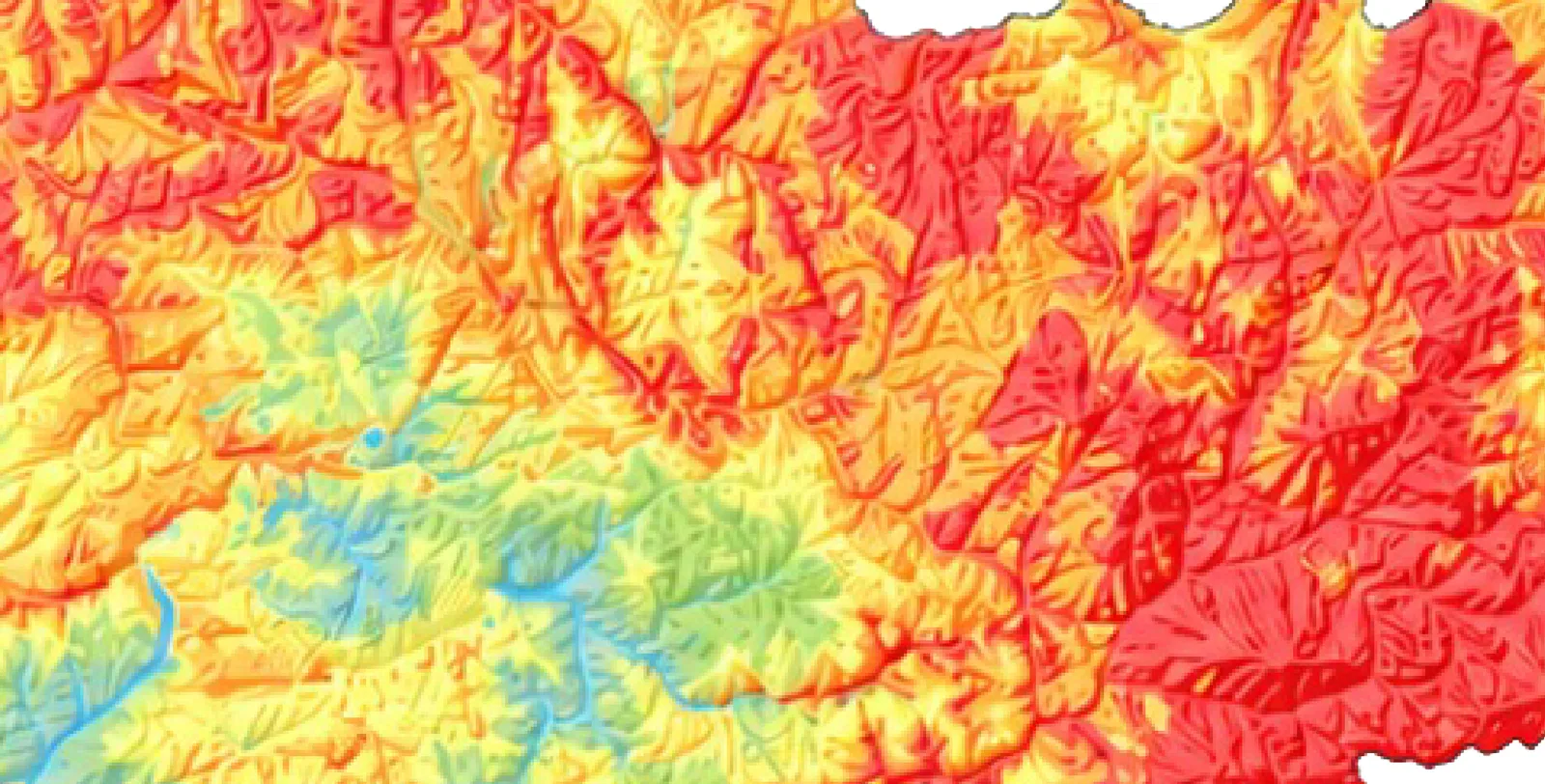
“Where have landslides, floods, cloudbursts and forest fires occurred?”
Hazard mapping
Multi-hazard inventory across landslide, flood, cloudburst and forest fire, with susceptibility surfaces from terrain, soil and rainfall.
“Who and what is exposed, and how would mitigation change the risk?”
Exposure & scenario modelling
Population and asset exposure quantified per hazard; mitigation scenarios tested against historical events.
“Which zones to restrict, mitigate, and monitor, at what cost?”
Intervention prioritisation
Intervention atlas; ranked priority zones, sequenced for capital and enforcement.
Where landslides, floods, cloudbursts and fires occur, who is exposed, and which intervention reduces the most risk per rupee.
Service overview
Across India’s fast-urbanising landscapes, townships, road corridors and housing projects are routinely sited without verified knowledge of flood, landslide or drought exposure. Existing assessments are often outdated, non-spatial, or too coarse to condition individual site decisions. In hill states like Uttarakhand, recent floods and landslides have hit areas where spatial risk intelligence could have guided safer development.
Anora Intel provides multi-hazard risk assessments, from susceptibility and vulnerability mapping to an integrated risk output, structured to the scale, hazard type and decision context of each engagement.
Service modules
Flood risk assessment
Safe siting of new developmentRainfall-induced inundation modelling from elevation data, river levels, reservoir storage, rainfall, drainage networks and census data. Outputs range from a risk zone map to a comprehensive flood model report.
Landslide susceptibility mapping
Infrastructure route planningSlope, geology, land cover, soil moisture, rainfall and historical events combined into susceptibility, vulnerability and hazard layers. Critical for satellite town siting in hill states.
Cloudburst risk mapping
Drainage investment prioritisationA historical event inventory and vulnerability assessment producing risk zone maps with gradient scoring. A near-real-time alert system is in development.
Drought monitoring
Agricultural and reservoir planningThree typologies: meteorological (SPI from IMD and ERA5), agricultural (NDVI, EVI, SMAP, MODIS) and ecological (LST, fire indices). Updated annually.
Applications
Safe development siting
Shows where townships and infrastructure can proceed safely, keeping investment out of flood plains, landslide corridors and ecologically sensitive zones before it is committed.
Master plan zoning and development conditioning
Risk outputs condition individual site decisions: construction restricted in high-risk zones, flood-resilient design required in moderate-risk areas, hazard zones defined for master plans and building regulations.
Infrastructure investment prioritisation
Quantified exposure data directs limited capital to the upgrades that reduce risk most per rupee invested: drainage, retaining walls, early warning systems.
Disaster management planning
Hazard maps, vulnerability assessments and exposure analyses feed district and state disaster management plans: vulnerable areas, critical infrastructure at risk, priorities for preparedness and response.
Environmental clearance and scheme applications
Risk assessments integrate into EIA and EMP reports, project justification documents and scheme applications, standardised to NDMA and MoEFCC guidelines.