
What we offer
Wastewater and effluent monitoring
Independent satellite monitoring of sewage treatment plants, industrial discharge points and receiving waterbodies. Detects the anomalies that on-site sensors miss or misreport.
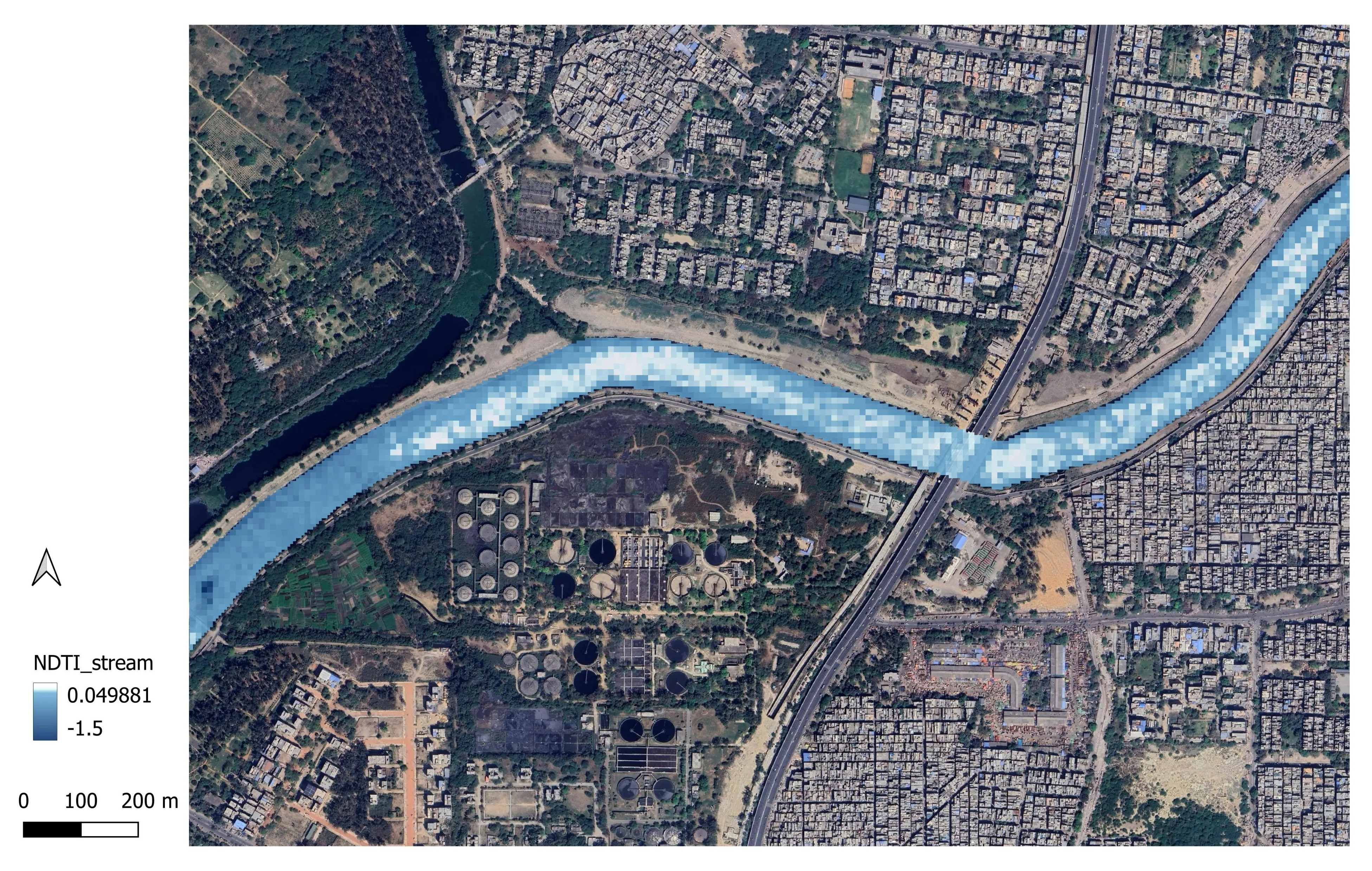
“Where is water pollution and what infrastructure is in place?”
Mapping
Turbidity, plume detection and surface-water health indicators at every monitored river, lake and reservoir.
“Which discharge points and catchments drive the signal?”
Source attribution & modelling
Catchment-level attribution linking plumes to upstream sources; scenario testing for treatment and buffers.
“Which sources warrant enforcement, which catchments need capital?”
Benchmarking & prioritisation
Repeat-cycle scoring directing inspection capacity under Namami Gange and AMRUT 2.0.
Where every monitored river and lake is polluted, where it comes from, and who to prioritise for enforcement and capital.
Service overview
India’s sewage treatment plants are required to meet CPCB discharge standards, but the monitoring relies on on-site sensors and manual sampling: costly at scale, and vulnerable to manipulation. Published reports document persistent sensor tampering and unauthorised bypass discharge at STPs across major cities, and no regulator can afford the inspection frequency it would take to verify the reported data independently.
Anora Intel monitors STP discharge behaviour and receiving waterbody conditions from satellite. The layer is independent of the plant: it runs continuously, scales across hundreds of plants at once, and cannot be bypassed by the entity being monitored.
Service modules
STP compliance monitoring
Regulatory compliance reportingContinuous monitoring of discharge behaviour. Detects plumes, spectral anomalies such as NDTI, turbidity and chlorophyll-a, and thermal signatures of untreated effluent. Optical by day, thermal by night; SAR for cloud cover is under development.
Inspection prioritisation
Directing enforcement capacityEach STP gets a compliance score and an inspection priority ranking from anomaly frequency, severity and predicted risk windows. Limited inspection capacity goes where it is most likely to matter.
Receiving waterbody quality monitoring
Cross-boundary pollution trackingRivers, canals and lakes downstream of discharge points, tracked over time. Supports trend analysis, cross-boundary pollution tracking and inter-state reporting.
Industrial effluent and supply chain due diligence
ESG evidence for investorsIndependent verification of industrial discharge compliance: an evidence layer for supply chain actors, financial institutions and investors.
Applications
Independent STP verification
An evidence layer that does not depend on operator-reported sensor data. The satellite sees the receiving waterbody, not the instruments inside the plant.
Scalable enforcement
The monitoring that covers one plant covers a hundred. City-wide or state-wide oversight at a fraction of the cost of equivalent ground inspection.
Enforcement prioritisation
Priority scores send inspectors to the sites where anomalies have been detected: more likely to find non-compliance, harder to anticipate.
Scheme reporting and certification
Supporting evidence for Swachh Bharat Mission ODF+ and ODF++ certification, Namami Gange programme reporting, and NMCG compliance documentation.
Deterrent effect
Continuous, independent monitoring raises the cost of non-compliance. The monitoring itself reduces bypass and tampering.